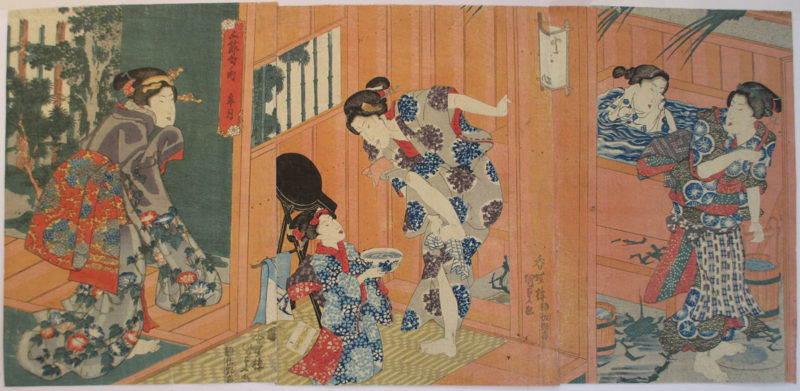
There is a bathing called “Shobuyu” for the seasonal event in May.At “Tango no Sekku” on May 5, Japanese were in “Shobuyu” or iris bath for the purpose of avoiding mischief.At that time, it was said that they were... Read More | Share it now!
Kashiwa-mochi(柏餅)The Beauty of wagashi
May 5th is a national holiday in Japan called “Children’s Day”. Originally called “Tango no Sekku”(端午の節句), it was the festival day for boys. On the other hand, March 3rd is the festival day for girls.... Read More | Share it now!
“Haruno” The Beauty of wagashi
The third stage in the history of Japanese sweets is the period of change from the Kamakura period to the Muromachi period (12th -15th century). During this period, Buddhist monks who studied in China spread Zen Buddhism. They popularized not only the... Read More | Share it now!
“Samurai” The kimono in Ukiyoe
There are formal and casual clothes. In some times, it was required as a rule rather than as common sense. Especially for the pre-modern upper class, such codes were very important. Rather than economic disparity, the difference in status became the... Read More | Share it now!
“Mizu no Ne” The Beauty of wagashi
Wagashi has been historically established through five stages. ① fruits and nuts② Mochi(rice cake) and Dango(dumplings) ③ Karagashi from China ④ Tenjin brought back by a Buddhist priest who studied Zen Buddhism in China ⑤ Nanbangashi, a... Read More | Share it now!