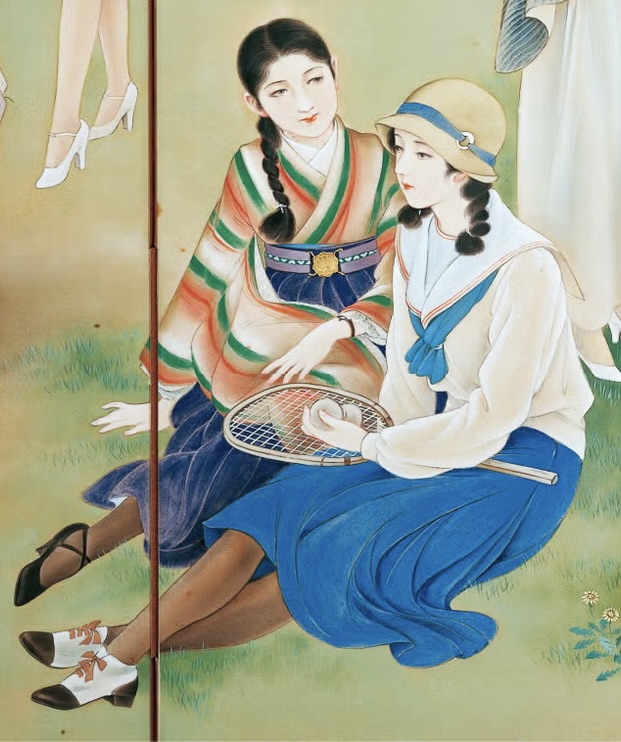
Meisen appeared in the 1910s and first became something close to a uniform for schoolgirls. More than that, the sharp rise in the number of young women entering higher education was what set the demand for this affordable silk kimono on fire.
The system of higher girls’ schools (kōtō jogakkō), where girls would study for several years after finishing primary school, was established in 1899. Enrolment stood at just over 56,000 in 1910, and over the next twenty years it would swell into the hundreds of thousands. Beyond the higher girls’ schools, the Taishō years saw a steep rise in the number of young women going to vocational schools and to specialist schools for sewing, nursing, typing and the like. Around 1920, the average age at marriage in Japan was twenty-one for women and twenty-five for men. The few years between leaving primary school and getting married — a stretch of time that earlier generations of Japanese women had never had — gave rise, for the first time, to a social layer of “girls” (shōjo) living through a kind of moratorium. They were the Japanese version of the layer that, around the same time in Europe, was being called the New Woman.


Left: Dyer’s shop flyer, 1904. Right: Used clothing and hardware shops’ joint flyer, c.1905. Both echo the bicycle-riding heroine of the 1903 novel Mafū Koifū. (Bicycle Culture Center)
The visible mark of that layer was the hakama. The hakama covered up the showy kimono beneath, kept the body out of decorative view, and signalled that this person was here to study. At the same time it was a practical, hygienic garment, one that let a young woman walk without minding the hem, and even ride a bicycle. It can be read as a halfway form between Japanese and Western dress. In its direction, it was not so far from the European reform dress that stepped out of the corset.
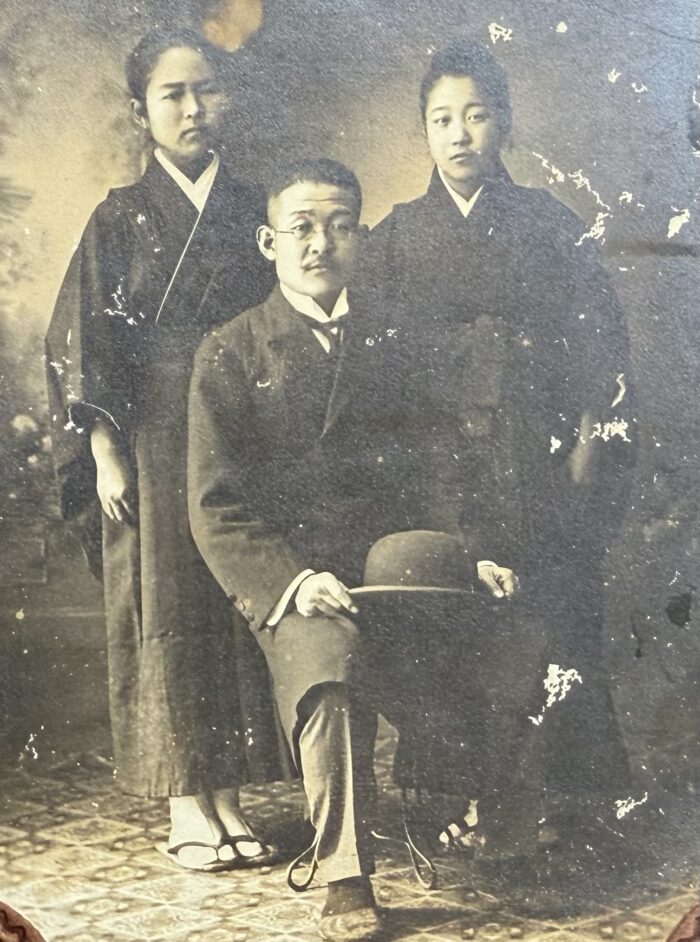
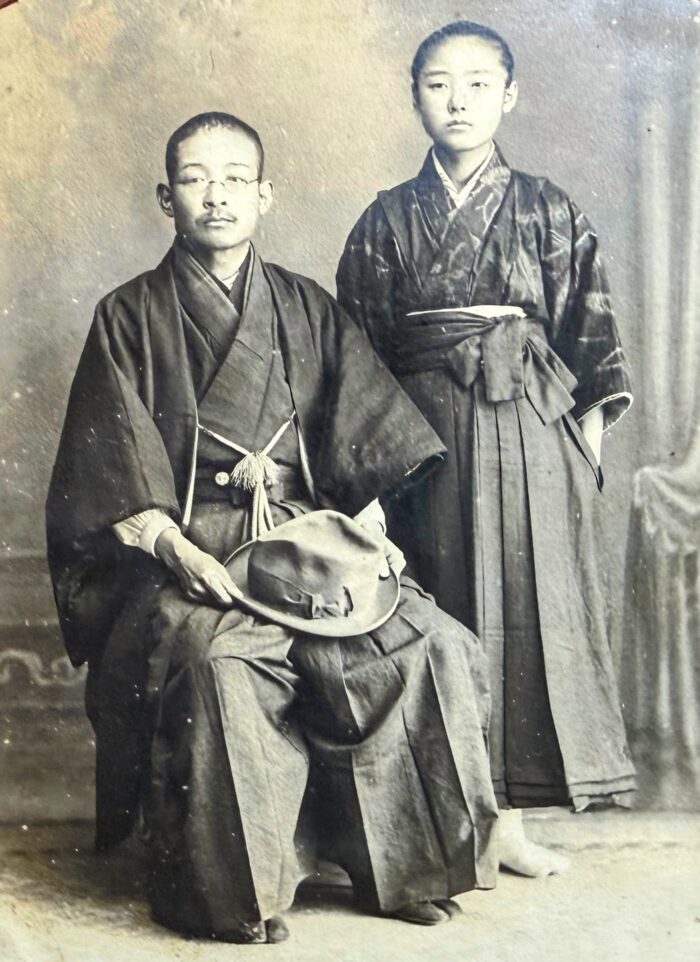
What, then, was being worn under the hakama? Gakushūin Women’s Department — the school for the daughters of the imperial family and the aristocracy — laid down its “Rules on Dress” in 1907. It limited the cloth of the garment to “cotton, linen, wool, tsumugi, meisen, and mixed weaves (all confined to inexpensive materials).” Meisen, in other words, was set as the ceiling: the most expensive kimono a girl was allowed to wear. Nogi Maresuke, the army general and hero of the Russo-Japanese War, took over as principal of Gakushūin in the same year. Plain living and a firm spirit was his watchword, and the dress rule is said to have been aimed at reining in the daughters of the upper class who competed with one another in the showiness of their clothes.
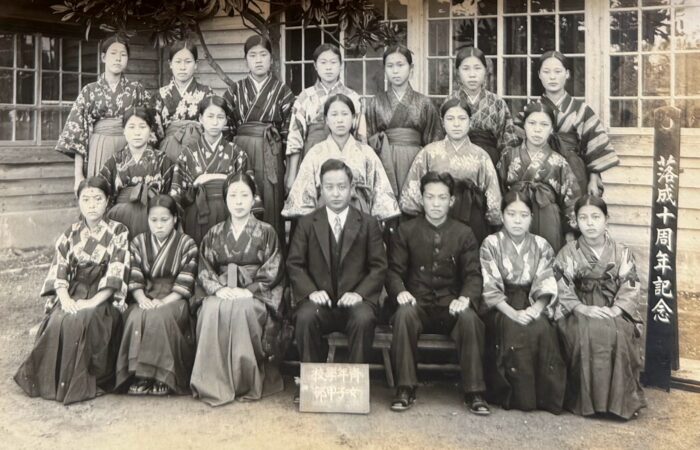
Advances in dyeing and weaving made it possible to load meisen with colour and pattern. A magazine from around 1930 carries a recollection from an official of the Isesaki weavers’ association: Nogi, the principal of Gakushūin, was said to have remarked that “Yūzen is altogether too luxurious, but meisen is too stiff.” The word reached the trade, and after a good deal of trial and study, colourful patterned meisen was the result. One can read this just as well from the other side: it was an answer to the demand of the “girls,” who had become a market of their own.
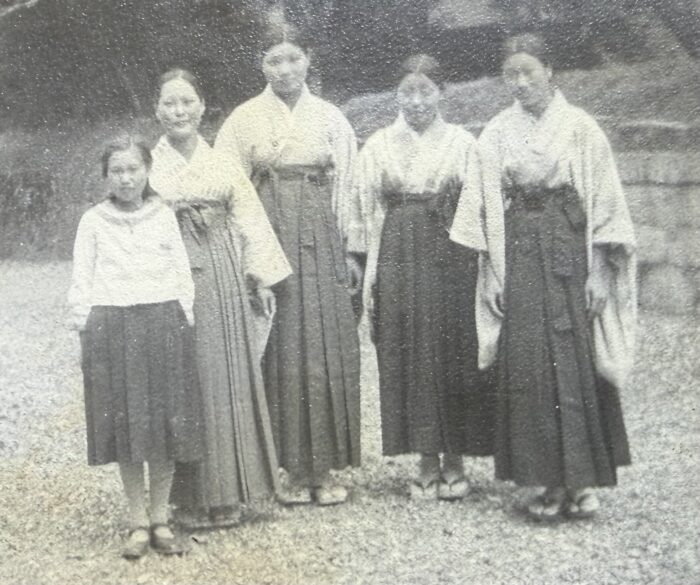
In girls’ higher schools through the 1920s and into the 1930s, the sailor suit was introduced as a uniform, in the course of a dress-reform movement that wanted more active clothing. The students themselves liked it: it was thought stylish, and it kept them visually distinct from the bus girls who wore Western-style uniforms for work. For parents, it was cheaper and more economical than a kimono. The upper-year students sewed the sailor suits of the younger ones on the school’s machines in their dressmaking classes, and the schools counted this as part of education. And yet, once they had graduated, the girls went back to not wearing Western clothes for years to come.


Left: Women of the general affairs section, January 1944. Right: Three young women in Western dress. (Author’s collection)
Still, the sailor suit that took hold among schoolgirls, and the sewing skill that came with it, helped smooth the way for the Westernisation of Japanese women’s dress. After the Second World War, a dressmaking boom swept the country; and the sailor suit, for its part, survived as the uniform of girls in middle and high school. Today it is known to anime fans the world over, simply as sailor fuku.