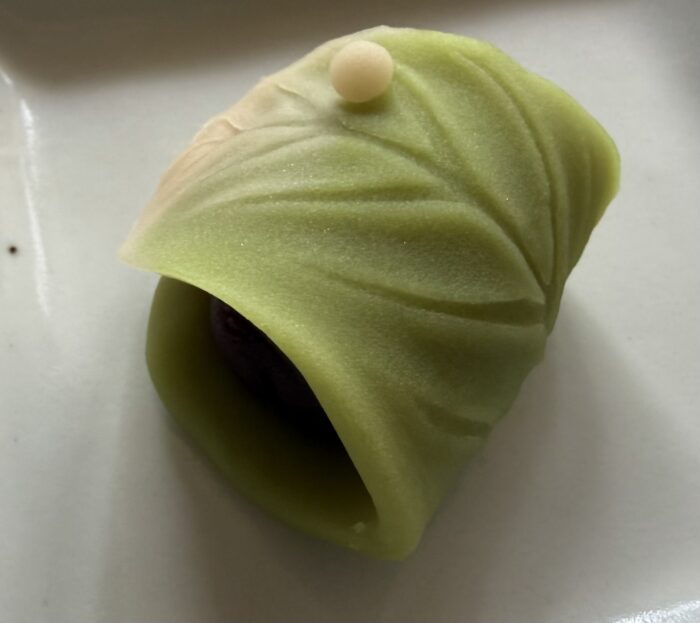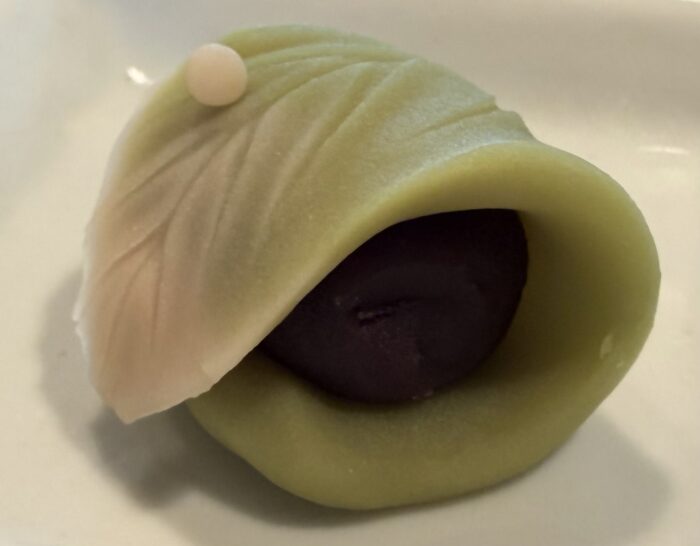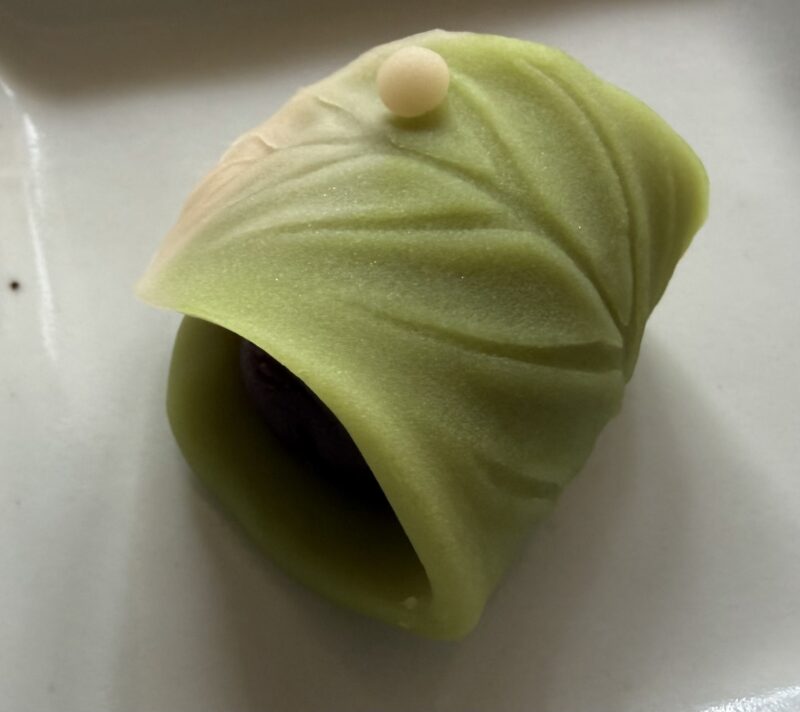
At a fair of long-established Kyoto shops in a Sapporo department store,, I bought an early-summer fresh sweet. A green leaf wrapped around smooth red-bean paste. It is called otoshibumi. Jōnamagashi are the highest grade of wagashi, served at the tea ceremony. They are made by hand and keep for two days. They are hard to find in Hokkaido; a department-store event is one of the few chances to meet a Kyoto sweet here.
In the tea ceremony, sweets mirror the season. Japan divides the four seasons more finely still — into twenty-four, even seventy-two. The fresh sweets of the Kyoto confectioner Tsuruya Yoshinobu change theme every half-month. A little earlier the motif was azalea; a little later it becomes Tanabata. Otoshibumi is a sweet for only a few weeks of early summer. Few sweet cultures in the world keep so strict a seasonal code. In a land of endless summer, such a world is unthinkable.
The sweet takes its name from the otoshibumi, a small beetle. In early summer the female bites a leaf, scores it, rolls it up, and lays a single egg inside. A cradle of curled leaf. Finding one fallen on the ground, people long ago saw a letter. An otoshibumi — a “dropped letter” — meant, in the Heian period (794–1185), a love letter left quietly on a road near the person one wished to reach. Letters then were written on rolled paper.
The Heian period corresponds, in Western terms, to the start of the long Middle Ages — from the coronation of Charlemagne to about the beginning of the Crusades. Through some four hundred years of peace, the court in Kyoto nurtured the culture of its aristocracy. The family that ruled the court in this age was the Fujiwara. They married their daughters to emperors, placed the sons those daughters bore on the throne, and held power as the emperor’s grandfather. A daughter’s marriage was politics itself.
The renowned poet Ariwara no Narihira (825–880) fell in love with Takaiko, a daughter of the Fujiwara. Takaiko was destined to marry the next emperor. Their love was forbidden; even when they ran away together, she was taken back.
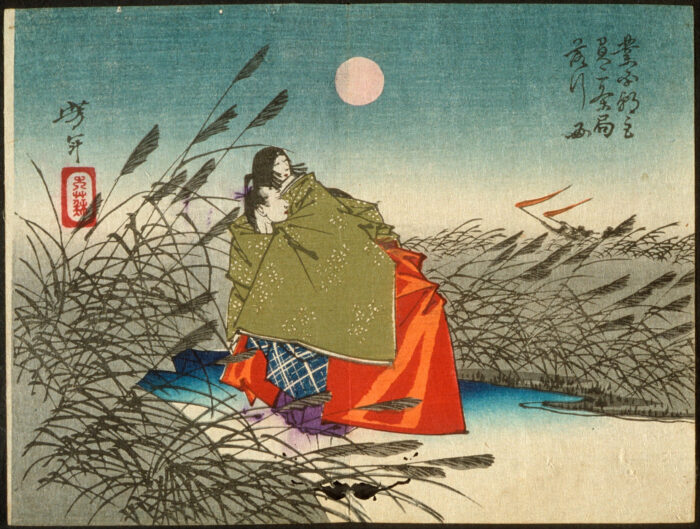
Takaiko later became an emperor’s consort. One day, before a folding screen painted with autumn leaves scattering on the Tatsuta River, Narihira composed a poem.
Chihayaburu / kamiyo mo kikazu / Tatsutagawa / kara kurenai ni / mizu kukuru to wa
— Not even in the age of the gods was such a thing heard: that the waters of the Tatsuta River should be dyed in so vivid a crimson.
The screen belonged to Takaiko, the woman he had once loved. To a woman now beyond his reach, Narihira offered a poem.


Fukuro obi — cherry blossom and maple on a vermilion ground
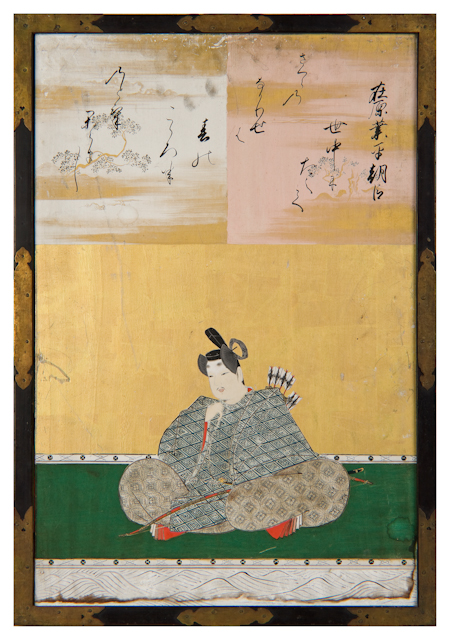
The poem that opens with chihayaburu is still known to many Japanese. The poet Fujiwara no Teika (1162–1241) chose one hundred poems, one each, as the Ogura Hyakunin Isshu. They became picture cards — played as karuta by families at New Year, and also in competitive tournaments. A high-school club became the subject of a manga, which grew into the popular film series Chihayafuru.
The small white grains on the sweet’s leaf. Those are the insect’s eggs. They could almost be morning dew.