Kimono has inspired the world of beauty to this day. Perhaps the most striking encounter came in the late 19th century, when Europe first met not kimonos themselves, but ukiyo-e prints depicting women wearing them.
Let’s start with Danae (1907/1908), one of Gustav Klimt’s masterpieces of erotic paintings. Klimt was the founding president of the Vienna Secession (1897), a movement that broke from academic tradition and absorbed influences from across Europe and beyond — including Japanese ukiyo-e.
This work is positioned as a group of works that pursue the mystery of women. In particular, “water spirit” and “air spirit” are the main themes, and “Judit II” (1901) is a representative one.
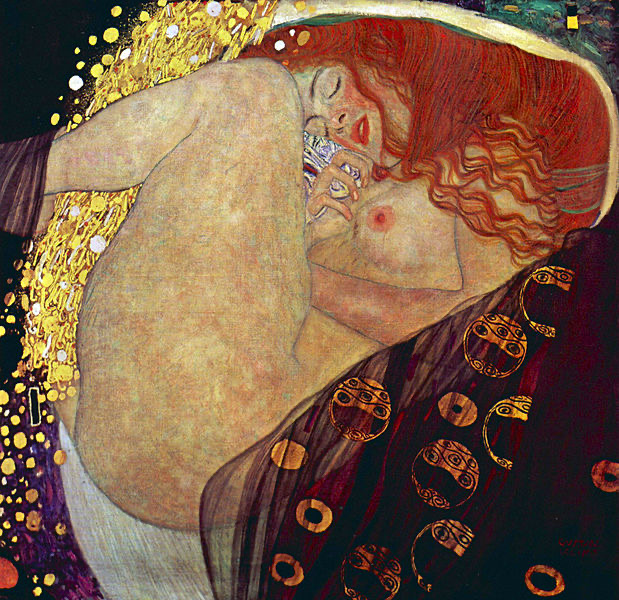
This painting is based on the famous Greek mythology. Zeus was trapped in the bronze tower by his father, Acrysios the King of Argos, but Zeus entered the tower in golden rain and fell in contact with Danae. Perseus was the son of Danae. In this painting, the golden rain flowing between Danae’s legs is said to be a symbol of Zeus.
Since Greek mythology is the subject of various nude paintings, Danae is also the subject of some paintings. Tiziano Vecellio during the Italian Renaissance also left several Danae and was said to have influenced Klimt. In the picture below, painted around 1554, naked Danae lies on the left side of Cupid, a symbol of Eros, and golden rain, the incarnation of Zeus, is pouring.
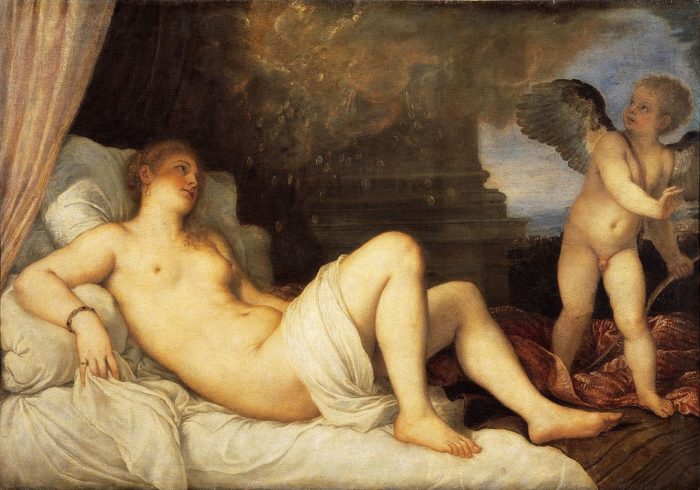
However, Klimt’s Danae has turned to the right. The golden rain is also large in grain and almost seems to be intersecting with Danae. Then, instead of the white bed sheets, a lace-like thin cloth with decorative patterns clings. Her thighs are rendered unusually full, almost exaggerated.
Klimt leaves “Lovers, Facing to the Right”, sketched in 1914, seven or eight years after Danae. However, although they are lovers, the man is not directly depicted — he is hidden under a polka-dot cloth. In the relationship between men and women, many of whom were drawn in the 1900s, men were also drawn properly. Both men and women were naked.
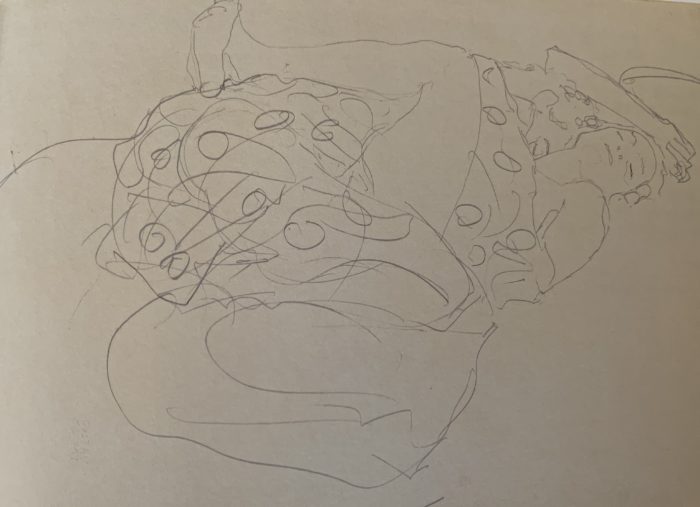
Markus Fellinger, a curator of Österreichishe Galerie Belvedere, sees the effects of ukiyo-e, or “Shunga,” on these sketches, depicting sexual activity between men and women. No explicit effects were observed in the 1900s, but they were evident in the 1910s. Moreover, the composition is clearly inspired by Shunga below. (Gustav Klimt: Vienna-Japan 1900, The Asahi Shimbun, Tokyo, 2019)
This shunga is a work by Utamaro Kitagawa (1753-1806) called “Lover under Sakura”. What stands out is that the two have sex while wearing formal kimonos, and they feel more eros in the gorgeousness of the kimono or cloth and the softness of the folds than the naked body. In the early days, Shunga depicting such sex acts of men and women often depicted the activities of naked men and women. However, men and women in unclothed clothing gradually came to be drawn, and it was Utamaro that caught the pinnacle of the “clothing eros”.
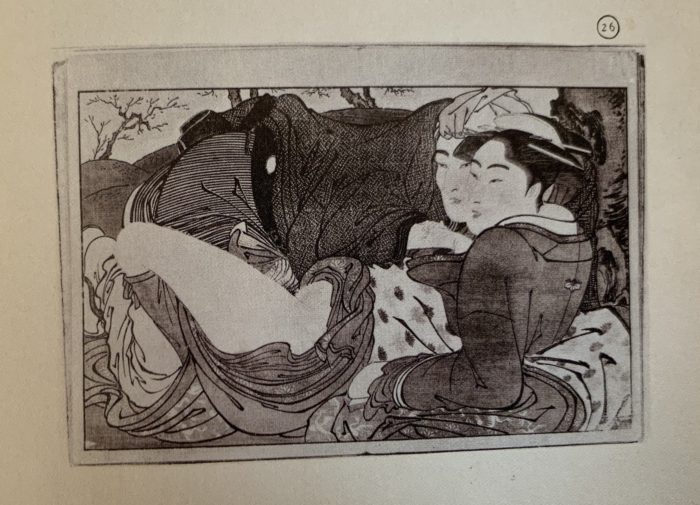

This time, I will not go into detail on the background, but it is my interpretation that Klimt may have paid more attention to the decorativeness of the kimono and the eros of the cloth, rather than to the shunga’s naked body.
Since Shunga is a painting that can be viewed and purchased confidentially, I am not sure what it is, but the curator said that a publisher in Munich, Germany, published an art book containing a black and white version of this print. It confirms that Klimt obtained it in 1907.
It’s subtle whether the 1907/8 “Danae” was inspired by Utamaro’s Shunga, but curators note that from around 1904 onward, Klimt was clearly inspired by Japanese ukiyo-e and erotic couples, and he produced a great number of drawings on these themes.
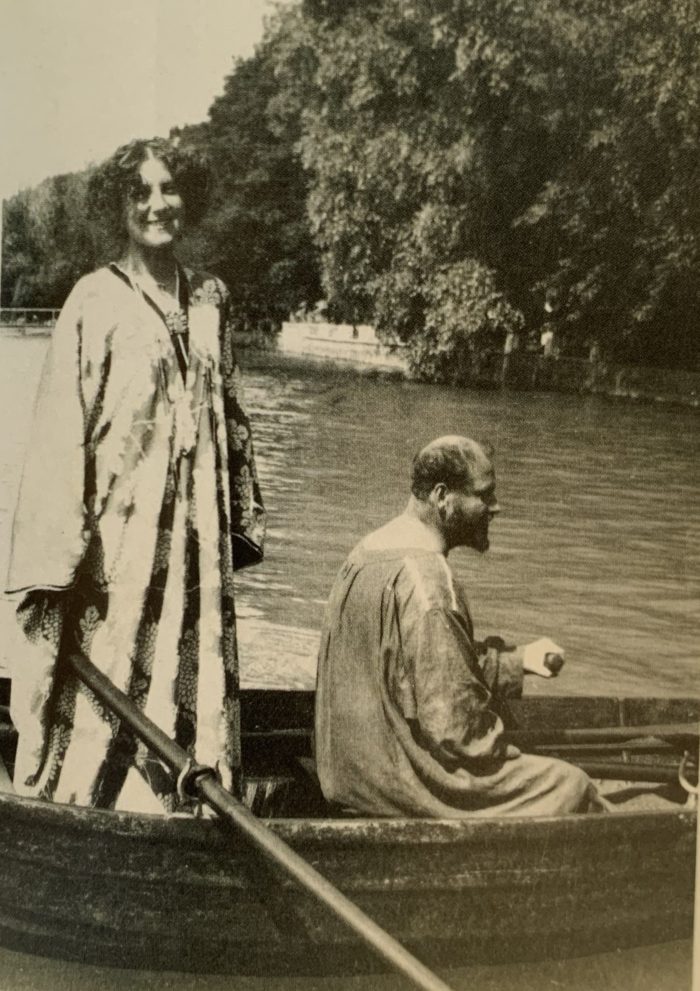
I speculate that Klimt’s inspiration from Kimono is largely related to his closest woman, Emilie Flöge. She was the owner of a famous clothing store in Vienna. Due to her influence, Klimt also worked on the design of the garment, leaving a picture of her wearing the garment. Around 1905, they enjoyed boating on the lake, wearing loose clothes, like a loose negligee.
The pattern on her clothes is not clearly visible, but looks like a chrysanthemum pattern. She collected a variety of textiles, including silk kimono fabrics.
It can be guessed that Klimt was looking at her kimono fabric, but it is also possible that they were showing each other their respective collections of ukiyo-e prints and kimono fabrics.
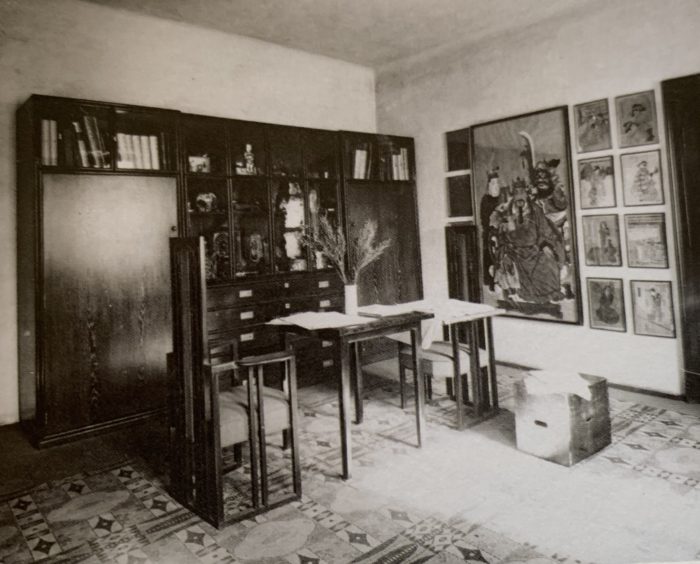
The photo below shows a photo of his atelier’s drawing room taken immediately after Klimt’s death. Twelve ukiyo-e, including a female figure, are displayed on the wall. Egon Schiele testifies that a similar number of ukiyo-e prints were on the opposite wall.